The American POWs
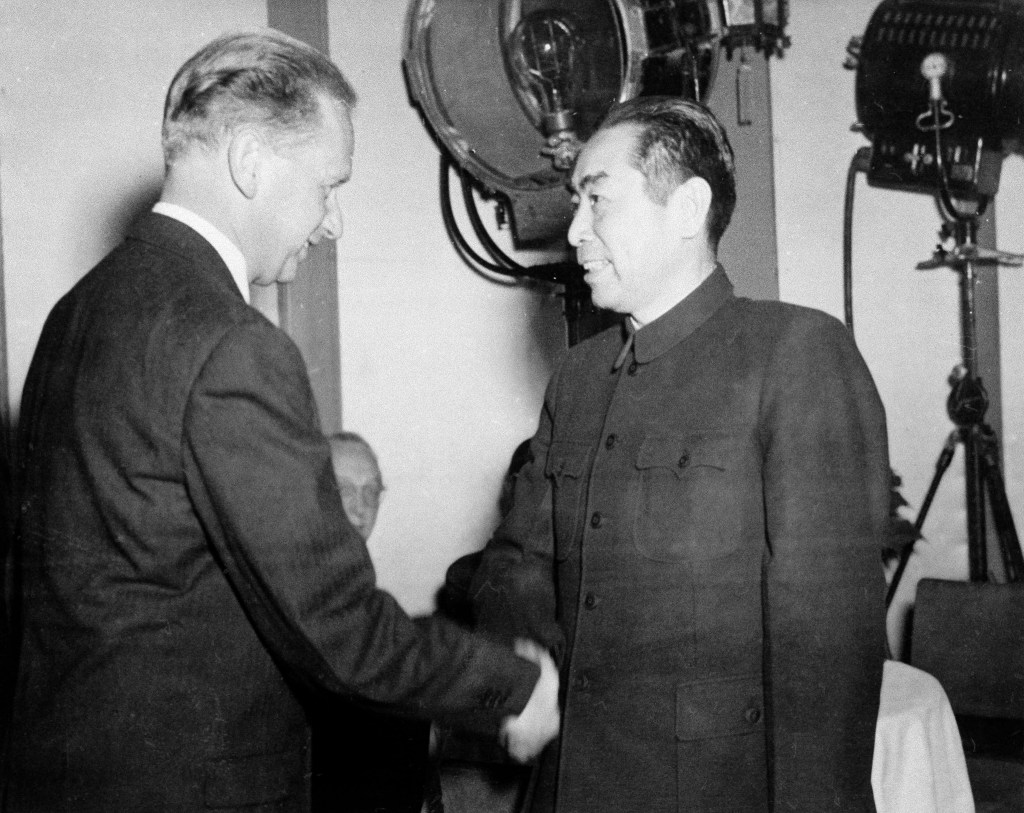
Eleven captured American airmen were branded spies by the Communist Chinese government in the autumn of 1954. The Korean Armistice Agreement, signed on July 27, 1953, called for an end to all hostilities and the repatriation of prisoners of war to their home countries. However, because the Chinese convicted the airmen of espionage, they were still in captivity and another diplomatic crisis brewed as American anger swelled. After several disappointments during his tenure, Dag was at last turned loose on the international stage to negotiate their release.
–Decoding the Unicorn: A New Look at Dag Hammarskjöld
From Dag’s Perspective…
A week or two later, I was sitting in my office when the phone rang.
“Hammarskjöld.”
“Dag, this is Henry Cabot Lodge.” His tone was strained. “I need to meet with you. Privately. It’s urgent.”
I glanced at the clock and noted that it was almost 10 a.m.
“Of course, Ambassador. Can you stop in straightaway?”
“No. There are too many people in the Secretariat at this hour. Can you see me tonight? Maybe around nine?”
A knot of concern formed in my chest. Ambiguity aside, whatever this was, it was serious.
“Sure. Come to the thirty-eighth floor, and I’ll be expecting you.”
“Thank you,” he replied, and the line went dead.
I replaced the receiver slowly, my mind spinning. The remainder of the day passed in a collection of routine tasks, but my thoughts returned to Lodge’s cryptic request.
By the time evening fell and the Secretariat emptied, I was antsy, waiting for the appointed hour. Something big was brewing; I could feel it.
The knock came precisely at nine o’clock. I rose and opened the door, revealing Lodge, the American ambassador to the UN.
He stepped inside quickly, glancing over his shoulder, his every movement telegraphing a sense of exigency and secrecy.
“Good evening, Dag.”
“Ambassador. Let’s move to the living room of my private quarters. In case anyone is still lurking around, they won’t disturb us in there.”
He followed me on the short walk, and I offered him a chair by the hearth. I had a fire going, and the environment was surprisingly homey.
But Lodge sat stiffly, his demeanor tense.
“I appreciate you meeting me like this, after-hours and discreetly. What I have to say couldn’t wait, nor could it risk the usual channels.”
My brow furrowed as I shifted onto the sofa opposite him.
I lit my thinking pipe and commented, “You have my full attention.”
“There are eleven American airmen trapped in China. They’re POWs from the Korean War who should have been released, but the Chinese branded them spies. They’ve been labeled criminals who attempted espionage, and Zhou Enlai’s government wishes to make an example of them.”
“What’s been done so far?”
“You know the tightrope we walk. The Cold War is everywhere, all the time. Dulles believes that if Eisenhower pushes Enlai too hard …”
“Nuclear war?” I inquired, praying I was wrong.
He nodded grimly.
“Unfortunately, that’s a real fear. Washington is gravely concerned.”
“And Eisenhower thinks the United Nations can help?”
“Not the United Nations, broadly speaking. You.”
I blinked.
“Me?”
“Yes. You are an impartial third party. Eisenhower and Dulles both hope that if anyone can talk sense into Enlai, it’s you. But I want to be more direct. The situation really is this: If you succeed, the airmen come home. It’s a victory for peace—and for America. If you fail …” he hesitated, his eyes steady but calculating. “… the failure will belong to you, not to the United States and not to Eisenhower.”
I grasped the pipe a little tighter as the implications were clear. The stakes were high: Lives hung in the balance, and so, perhaps, did the fragility of the Cold War.
Publicly, I was quick to say that the UN was a work in progress, which was true. Personally, however, I always took it to heart if I felt like I had failed someone.
This negotiation with Enlai held a lot of promise—a chance to rescue the soldiers, to demonstrate the power of diplomacy, and to cement the UN’s relevance in a divided world. Of course, it held many risks, too.
I rose from the sofa and walked to the window. Below, the lights of the city stretched endlessly into the night. Before I could respond, Lodge continued:
“If you agree, I’ll bring a formal motion to the General Assembly tomorrow. If not, I suppose things would be rather awkward because, to be blunt, I’ll bring the motion anyhow. I recognize that we’re painting you into a corner.”
“Not really. This is my job. International mediations and going where others cannot are integral to what I do here. When you make the proposal, I’ll be ready. You have my word.”
Lodge’s relief was evident in his posture.
“Thank you. I’ll inform Eisenhower immediately.”
I turned to face him, my heart thumping against my ribs.
“One caveat I will give you: I go as UN Secretary-General, not as a tool of the West. There will be no interference from Washington and no strings attached. I will do whatever is possible and ethical to get those men home again. What the UN Charter says I cannot do, I will not do.”
“Understood.”
I envisioned the path ahead—a delicate, dangerous dance with Zhou Enlai, a man as treacherous as the crisis itself. But for me, this was not merely a political mission. It was an opportunity to prove that even in the darkest of times, reason and dialogue could prevail.
Lodge excused himself, and I poured a glass of wine. This was no circumstance where telegrams and letters would suffice. For something like this, a trip to Peking was the only option. I needed to shake Enlai’s hand and look him in the eyes.
-From my forthcoming work, Simply Dag
To experience more of Dag’s remarkable journey—told in his voice and spirit—Simply Dag releases July 29th.

Explore more:
- 5 Surprising Things You Didn’t Know About Dag Hammarskjöld
- Quiet Doesn’t Mean Weak: How Dag Hammarskjöld Refused to Be Bullied
- The Tender Side of Dag Hammarskjöld
- We ARE in this Together
New to Dag’s life and legacy? Start here.
You can purchase Sara’s award-winning biography Decoding the Unicorn: A New Look at Dag Hammarskjöld on Amazon by clicking here! Her forthcoming project, Simply Dag, will release globally on July 29, 2026.
 Join the Unicorn Dispatch newsletter here: https://sara-causey.kit.com/2d8b7742dd.
Quoted material from Decoding the Unicorn and Simply Dag © Sara Causey.
Photo credit: United Nations Secretary-General Dag Hammarskjold shakes hands with Chou En Lai during a visit to Peiping, Jan. 14, 1955. (AP Photo). Used with paid license.