I’ve picked up certain Dag habits. And that’s literally what I call them. He loved hiking, nature walks, and photography. I started those activities out of closeness and soon thought, “I understand why these activities have so much appeal. I get it now.”
Shinrin-yoku, or forest bathing, has a number of benefits, ranging from lowering stress to increasing mindfulness and improving mood. One of my favorite things about hiking is that, for a little while, the world gets calmer. You hear the sounds of nature. Birdsong, squirrels skittering from tree to tree, leaves falling, water babbling, etc.
It’s a way to escape notifications, ads, political signs, billboards, social media bickering, and the endless stream of opinions flung at us in modernity.
If you feel like someone is watching you, it could turn out to be a little cutie like this:

On a recent hike through a local nature preserve, I stumbled across a painted “kindness rock” sitting on a bench. The message itself wasn’t inherently objectionable:
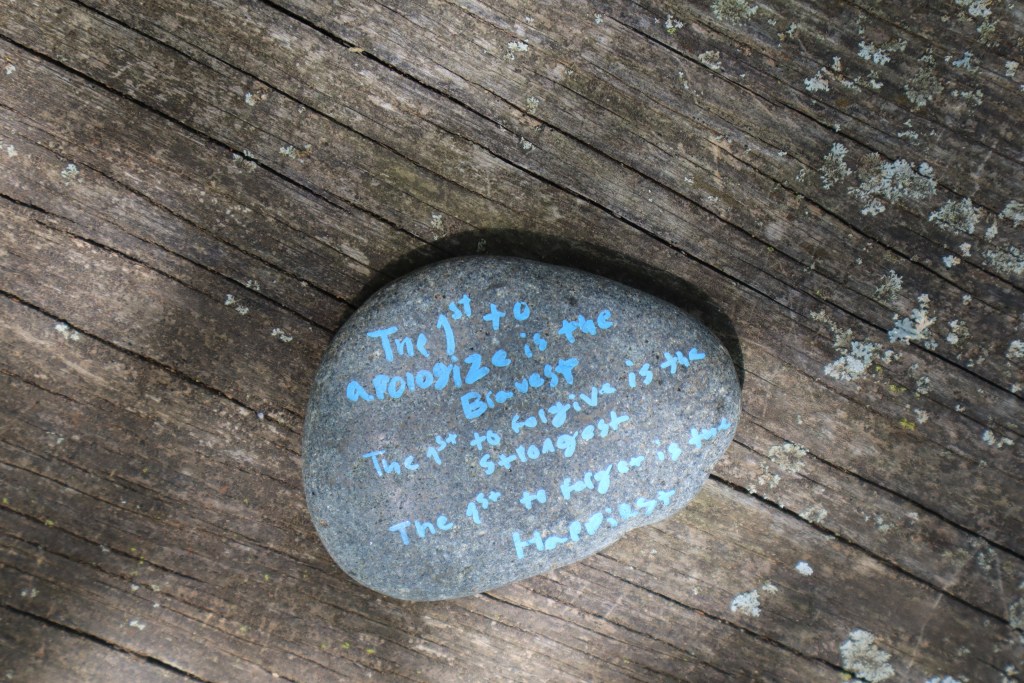
The 1st to apologize is the bravest. The 1st to forgive is the strongest. The 1st to forget is the happiest.
To me, the sentiment isn’t the problem; the location is.
A Nature Preserve Isn’t a Community Bulletin Board
We live in a world where nearly every surface has become a place for human commentary. Social media, advertising, signs, QR codes, and inspirational quotes follow us almost everywhere we go.
Theoretically, at least, a nature preserve is one of the few places left where we can step away from everyone else’s messages. We enter the home of deer, raccoons, squirrels, groundhogs, birds, butterflies, wasps, spiders, fungi, mosses, wildflowers, and countless other living things. It’s their space—not ours.
Nature doesn’t need us to decorate it.
Good Intentions Still Have Consequences
The person who left the painted rock almost certainly meant well. Kindness matters.
But so does stewardship.
The principle behind Leave No Trace is simple: don’t ask whether your one action is a problem. Ask what would happen if everyone did it.
One painted rock? Not a catastrophe.
A hundred painted rocks? Now every bridge, bench, trail marker, and overlook becomes a display of human messages instead of a natural landscape.
That’s exactly why Leave No Trace encourages us to leave natural places as we found them.
Even the Kindness Rocks Project Agrees
Interestingly, the Kindness Rocks Project itself encourages participants to follow Leave No Trace principles and specifically asks people not to leave kindness rocks in national parks or on hiking trails.
That’s an important distinction.
A painted rock at a library, hospital, or participating business may brighten someone’s day. (Though I would argue it’s still important to verify if you’re allowed to deposit such things on someone else’s property.)
A painted rock inside a nature preserve changes the experience of the place itself.
We’ve Seen This Before
Unfortunately, this isn’t the only example of people forgetting why protected natural spaces exist.
Recently, the caretaker of this very preserve photographed the aftermath of a gender reveal party where the guests left glitter and confetti scattered through the woods.
We’ve all seen the headlines:
- Tourists getting too close to bison.
- Visitors harassing wildlife for the perfect photograph.
- Wanderers drifting into Yellowstone’s hot springs, which is both illegal and dangerous.
- People leaving trash where animals live.
- Decorations, ribbons, confetti, balloons, and other items left behind because someone wanted to make the moment “special.”
The irony is that these places are already special.
That’s why they’re protected.
Let the Forest Speak
Dag Hammarskjöld found great meaning in nature. Forests, mountains, and long solitary walks weren’t places he went to leave messages behind for other hikers. They were places where he listened.
I think there’s wisdom in that. If I want to write about courage, forgiveness, gratitude, or kindness, I’ll write it here on my blog. The woods don’t need my commentary. Or, quite frankly, anyone else’s.
Sometimes the greatest kindness we can offer the next visitor is an uninterrupted experience with the natural world.
Take photographs. Leave only footprints. Leave the woods to the woods.
Explore more:
- Nature Through a Lens
- Remembering Dag Hammarskjöld: His Life, Legacy, and Enduring Relevance
- The Tender Side of Dag Hammarskjöld
- 6 Things You Didn’t Know About Dag Hammarskjöld
New to Dag’s life and legacy? Start here.
You can purchase Sara’s award-winning biography Decoding the Unicorn: A New Look at Dag Hammarskjöld on Amazon by clicking here! Simply Dag: The Private Man in a Public—and Dangerous—Office is now available anywhere Amazon books are sold: https://a.co/d/0f9PAg9g.
Enter the private room for readers who look beyond the surface.  Join the Unicorn Dispatch newsletter here: https://sara-causey.kit.com/2d8b7742dd.
Photographs © Sara Causey. For downloadable photos free to use for your projects, check out my Unsplash page: https://unsplash.com/@saracausey.