Dag Hammarskjöld’s Early Life: The Childhood of a Swedish Diplomat
Before he walked the halls of the United Nations and made history as one of the most respected Secretary-Generals the world has ever known, Dag Hammarskjöld was a boy with a vivid imagination and a deep love for nature. In this post, I’ll explore the early life of Dag Hammarskjöld — the Swedish diplomat whose quiet strength began in childhood. From dreamy afternoons in the woods around Uppsala Castle to the weight of his noble lineage, his origins reveal the seeds of the man he would become.
The Boy from Jönköping: Where Dag Hammarskjöld’s Story Begins
It was a warm summer day in Jönköping—the kind when birds sing and children stay out to play, enjoying the lengthy sunlight before a long winter creeps in. The nearby Vättern Lake shimmered with gentle waves as a few terns caught fish and large swans glided along the surface. The scent of pine trees mingled with a light, crisp breeze that drifted down from the surrounding highlands. Inside a modest home, the tranquility was interrupted by the first cries of a newborn. On this afternoon of July 29, 1905, Dag Hammarskjöld entered the world—a small ripple in the vast tapestry of life, yet a moment of great joy for his mother, Agnes. She had been hoping for a little girl, a final addition to the family of sons, but as she gazed down at the baby, she had to smile. He was beautiful—more perfect than she could have imagined. His tiny, peaceful face charmed her instantly, and all thoughts of a daughter faded.
Dag Hammarskjöld’s Childhood at Uppsala Castle: A Swedish Upbringing
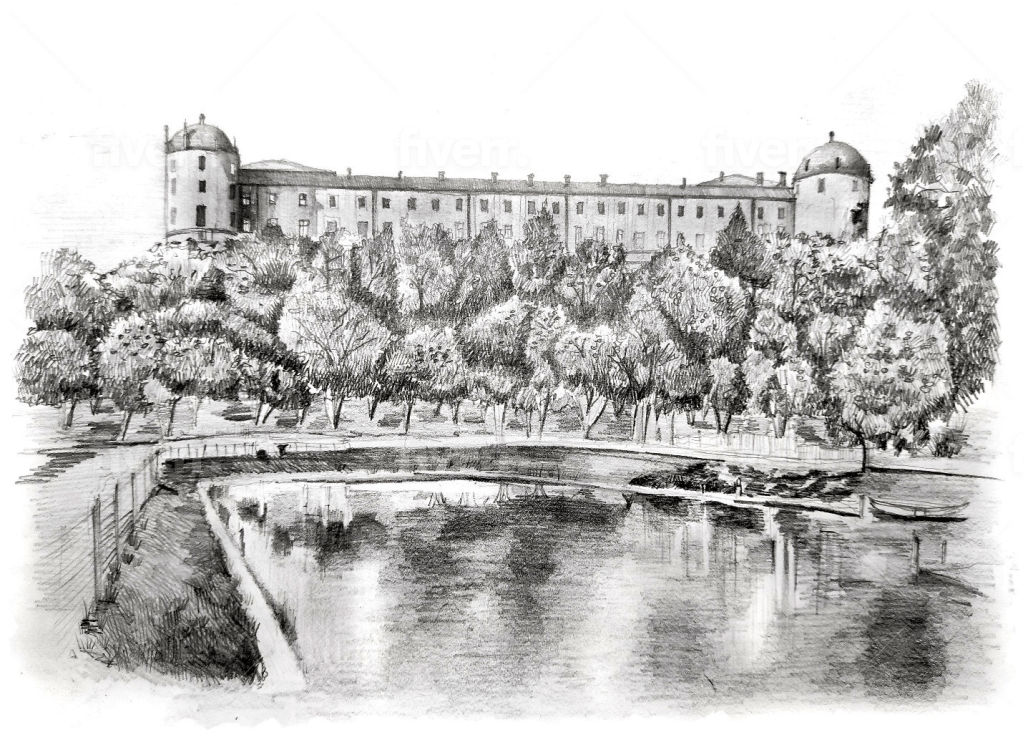
When Dag was nearly ready for primary school, Hjalmar was appointed Lord Lieutenant of Uppsala, and the family moved into Uppsala Castle (alternatively called Vasa Castle), which remains today.
Artist Valery Alampiev’s rendering of Uppsala Castle during the time the Hammarskjöld family lived there, November 2024.
Dag felt like he was stepping into a storybook. As they passed beneath the towering stone walls, he couldn’t help but stare in awe. A place where real kings and queens had lived? How amazing! But reality soon set in. The grandeur of royalty had long faded, replaced by the stark furnishings of Hjalmar’s austere sensibilities. The halls felt cold; the décor was minimal, and shadows seemed to gather in the corners of every room. Several fires had broken out in times past, and restorations were not always completed. Hjalmar and Agnes instructed the boys that certain parts of the place were strictly off limits due to potential dangers.
Dag’s curiosity, however, was piqued by the legends: The castle was rumored to be haunted, and though he wasn’t sure if ghosts were real, the idea intrigued him. In the musty dungeon, rusty shackles still clung to the walls like skeletal remains of a forgotten era. It was the perfect setting for the stories his older brothers loved to tell.
-Ibid.
Dag Hammarskjöld and the Forest: A Love for Nature
The castle’s surrounding grounds became a rich source of inspiration, and Dag possessed a treasured collection of insects and pressed plants. He felt drawn to the legacy of Carl Linnaeus, the eighteenth-century Swedish botanist who refined the modern system of binomial nomenclature for classifying plants and animals. Linnaeus was a professor at Uppsala University and an explorer who found both scientific discoveries and spiritual communion in northern Sweden. The two must have been kindred spirits because Dag was likewise drawn to nature’s finest details while also craving the open spaces of meadows, valleys, and mountains, always seeking the balance between the minute and the vast. … Though the area is more developed today, in Dag’s childhood it was still a relatively isolated place, surrounded by fields and trees. With so much unspoiled land, it made a fantastic playground for Dag. The wilderness beckoned, and he would lose himself in the tall grass, searching for insects and small fauna of all kinds. The landscape, with its rolling hills and forests, was his realm to explore, feeding his imagination and deepening his connection to nature. He found comfort in solitude and even as a youngster, Dag realized a kind of kinship with plants and animals.
-Ibid.
Dag Hammarskjöld’s Love of Books: A Young Scholar
From early on, Dag was an avid reader. He had an innate curiosity about the world and was interested in a variety of subjects. The castle had a wonderful library, and Dag diligently worked his way through all of the children’s books therein. Of course for someone as bright as Dag, it didn’t take long to graduate from kids’ stories to adult reading. And Uppsala was a fantastic setting: a pretty town with a university and plenty of traditional Swedish culture. Looking out the high windows of the castle, Dag could see Uppsala Cathedral and within its walls, Dag had access to Hjalmar’s extensive collection of books, which he was allowed to borrow. Rather expectedly, Dag’s school performance was excellent. His brothers had been fine students and the same was demanded of Dag, who didn’t disappoint. Dag’s teachers noted that he was studious, responsible, and had a strong attention to detail —he was no class clown or troublemaker. He also had an excellent memory and was well able not only to grasp information but to retain it. So good was he with academics, Dag had a childhood notion that he might become an educator one day. He loved the sensation of learning something new, of seeing the world through someone else’s eyes, and realizing that another person has felt the same emotions. Reading brought a sense of cohesion to Dag’s world, and he knew that knowledge was meant to be shared, not hoarded. One afternoon while sifting through a challenging work, Dag had an epiphany.
“I should become a teacher!” he smiled.
His mother particularly supported this idea and believed academia was a noble profession. A highly intelligent boy like Dag seemed destined for the classroom.
-Ibid.
Want to dive deeper into Dag Hammarskjöld’s life? Discover more in Decoding the Unicorn!
Curious about Dag Hammarskjöld’s legacy?
Explore more about the life and impact of one of the most respected United Nations leaders: